How to Write a Legally Valid Lease Termination Letter
Team LeaseTerminationLetter
·Published
Quick Answer
To write a legally valid lease termination letter, clearly state your intent to end the lease, include the exact property address, your contact information, the current date, and your effective move-out date. Ensure you provide the correct notice period required by your state law (typically 30 or 60 days) and send the letter via USPS Certified Mail with a Return Receipt requested.
Are you preparing to move out and need to know how to write a legally valid lease termination letter? Whether you are a tenant looking to end your rental agreement or a landlord issuing a notice, doing it correctly is crucial to avoid legal disputes and financial penalties. In this guide, you will learn the exact elements required, state-specific notice periods, and the best delivery methods to protect your rights.
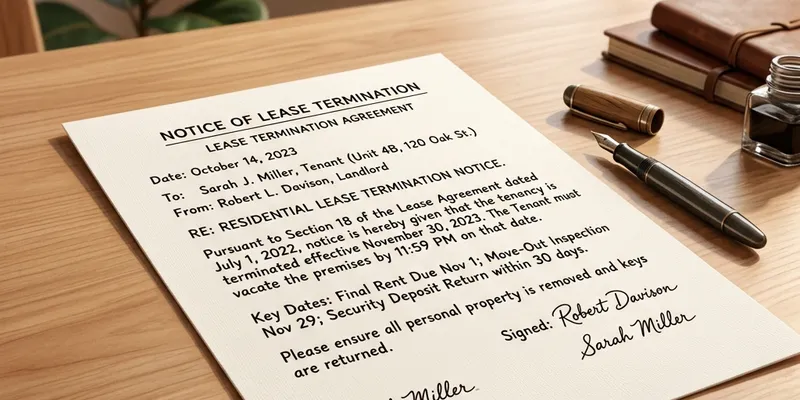
What Is a Lease Termination Letter?
A lease termination letter is a formal legal document sent by a tenant to a landlord (or by a landlord to a tenant) declaring the intent to end an active residential lease agreement. When drafted correctly, it serves as indisputable proof that you provided proper notice according to both your specific lease terms and local state housing laws.
Remember, this is not an eviction notice. It is a standard procedure used when a lease term is naturally ending, when breaking a lease early under valid conditions (such as military deployment under SCRA regulations), or when ending a month-to-month tenancy.
Essential Elements of a Legally Valid Letter
To ensure your letter holds up in court or prevents a landlord from improperly keeping your security deposit, it must include the following critical components:
- Current Date: Establishes the exact timeline of your notice.
- Parties Involved: Full legal names and addresses of both the landlord/property manager and the tenant(s).
- Property Details: The complete address of the rental unit, including apartment number.
- Clear Declaration: An unambiguous statement that you are terminating the lease.
- Move-Out Date: The precise date you will surrender the keys and vacate the premises.
- Forwarding Address: Where the landlord should send your security deposit.
- Physical Signature: A wet-ink or legally binding electronic signature.
Step-by-Step: How to Write the Letter
Step 1: Format as a Formal Business Letter
Begin with your contact information at the top, followed by the date, and then the landlord's contact information. Use a professional salutation such as "Dear [Landlord's Name]."
Step 2: State Your Intent Immediately
Do not use vague language. Your opening sentence should be direct: "Please accept this letter as formal written notice of my intent to vacate the property at [Address] on [Date], terminating my lease agreement."
Step 3: Address Move-Out Procedures and Deposit
Request a final walk-through inspection to assess any potential damages and provide your new mailing address so the landlord knows where to send the remainder of your security deposit within the state-mandated timeframe.
State-Specific Notice Periods Explained
A legally valid lease termination letter must comply with your state's minimum notice requirements. Providing insufficient notice is the most common reason tenants lose their security deposits or face penalties.
- 30 Days: The standard for most states (e.g., California, Texas, New York) for month-to-month leases.
- 60 Days: Required in states like Delaware, or for tenants who have lived in a California property for over a year.
- 15 to 20 Days: Required in a few states like Florida (15 days) and Washington (20 days).
Always verify the laws in your jurisdiction using our State-Specific Guides before submitting your notice. You can also consult the Cornell Law Institute's landlord-tenant overview for additional context on statutory requirements.
Proper Delivery Methods
Writing a perfect letter means nothing if you cannot prove you delivered it. Do not rely solely on email or text messages unless your lease explicitly permits electronic notices.
The most secure method is sending the letter via USPS Certified Mail with Return Receipt Requested. This provides a paper trail proving exactly when the landlord received the document, protecting you from claims that the notice was never delivered. Visit USPS.com for current certified mail pricing and procedures.
Ready to Terminate Your Lease?
Skip the guesswork and ensure your notice is 100% compliant. Use our free tool to generate a state-specific, legally valid lease termination letter in seconds. No sign-up required.
Generate Your Free Letter Now →Frequently Asked Questions (FAQs)
What makes a lease termination letter legally valid?
A legally valid lease termination letter must include the current date, property address, landlord and tenant names, a clear statement of intent to terminate, the effective termination date, and a physical signature. It must also comply with your state's notice period laws.
Can I send a lease termination letter by email?
While some landlords accept email informally, most state laws require lease termination notices to be delivered in writing via USPS Certified Mail or personal delivery to be legally binding. Always check your specific state laws and lease agreement before relying on email.
How much notice do I need to give to terminate my lease?
Notice periods vary by state and lease type. Month-to-month leases typically require 30 days' notice in most states, but some require up to 60 days. Fixed-term leases usually require notice 30 to 60 days before the lease end date.
Should I include my forwarding address in the notice?
Yes, you should always include your forwarding address in your lease termination letter. This ensures the landlord knows exactly where to send your security deposit return and final statement of account.
Related Articles
- 30-Day vs 60-Day Lease Termination Notice: Which Do You Need?
Understand whether you need a 30-day or 60-day notice with a state-by-state breakdown.
- Why You Must Send Lease Notices via Certified Mail
Learn why USPS Certified Mail is the only legally secure way to deliver your notice.
- Early Lease Termination Letter: When and How to Break Your Lease
Complete guide to breaking your lease early including legal grounds and cost minimization.